If you detected a certain lack of “joie de vivre” in my last post, you would have been right. The jokes and witty observations I spent the first half of the walk distilling, evaporated in the heat and effort of the walk through Auchel to La Buissière in the afternoon.
However, as the saying goes “what a difference a day makes.” Today, despite walking very nearly as far, I spent none of it wondering how I could cut my feet off, or jump on the back of a lorry, or hijack a ubiquitous e-scooter. In fact, to look at me today, you would say: “There goes a fellow whose “vivre” is positively packed full of “joie.”
This outcome was less than certain at the beginning of the day, as my hotel lay 4km off the Via Francigena. I had to walk down from La Buissière to Bruay before the clock was even running. This did however give me the chance to experience these former mining towns through less jaded spectacles. Well, I say towns, Bruay and La Buissière decided to set aside any differences, bury hatchets and the like and become one town in 1987.
In the fresh morning air, I could appreciate the miner’s cottages, whose design was everywhere. (I’d seen these in Auchel and Marles-les-Mines yesterday as well).
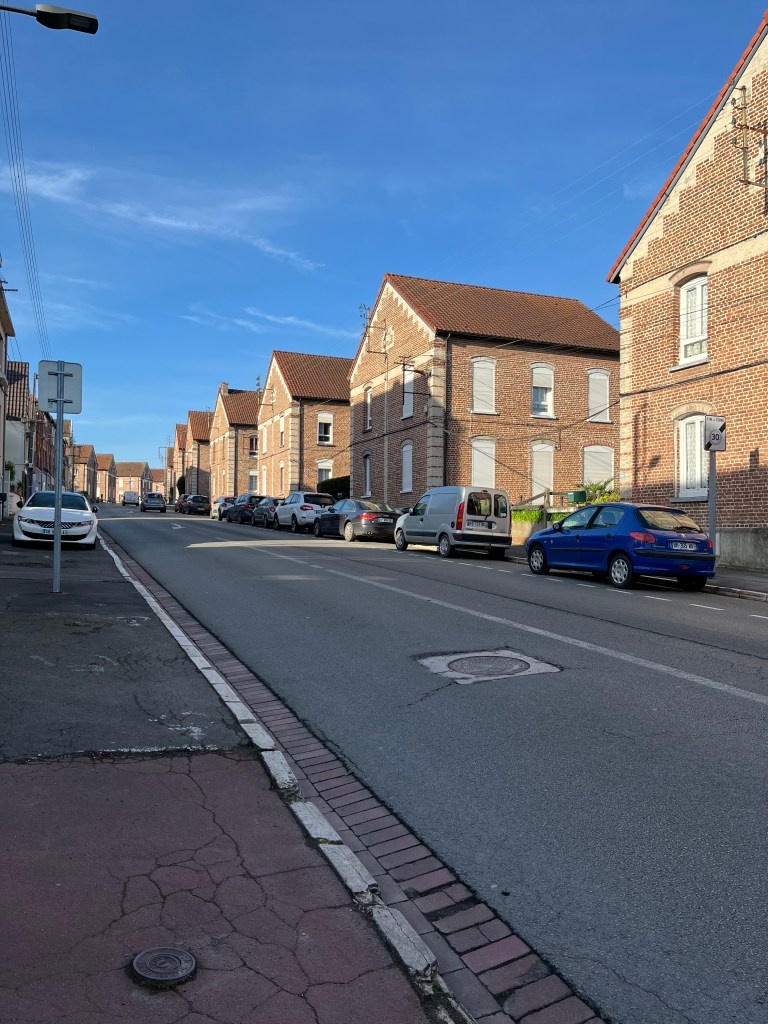
I suspected that housing of lesser quality had been demolished, but even so, these strange semi-detached houses, with their front doors perpendicular to the street, gave a very good living environment for the miner. Much better than the back-to-back terraces in mining towns in the UK. Incidentally, my friends’ first house was a back-to-back terrace in Leeds. Such housing had been outlawed by the Housing Act of 1909, however the Leeds City Corporation argued that “back-to-back housing provided affordable accommodation for the working man.” Leeds utilised a loophole that allowed pre-approved schemes to be built, and thus kept building them until 1937. Tom and Jasmine’s house dated from around this time and so they therefore lived in one of the last back-to-backs to built in the country.
Anyway, this might have counted as a digression, particularly as these French houses would better be described as side-to-side. Perhaps a better indication of poorer, more cramped accommodation is the Cité de Électriciens.

These houses were built by the Bruay Mine Company between 1856 and 1861 to house the families of miners working at No 1 Pit nearby. They didn’t house electricians, but the company chose the names of scientists who had made great discoveries in electricity. So Ampère, Marconi, Volta, Edison, Coulomb, Franklin and Faraday all make an appearance. Today the site is a cultural centre and provides pilgrim accommodation too. Sadly they were booked up when I enquired.
Beyond the art deco town hall, I picked up another former railway line. There really is a lot to be said for walking around a post-industrial city. Old railway lines make lovely level walks.
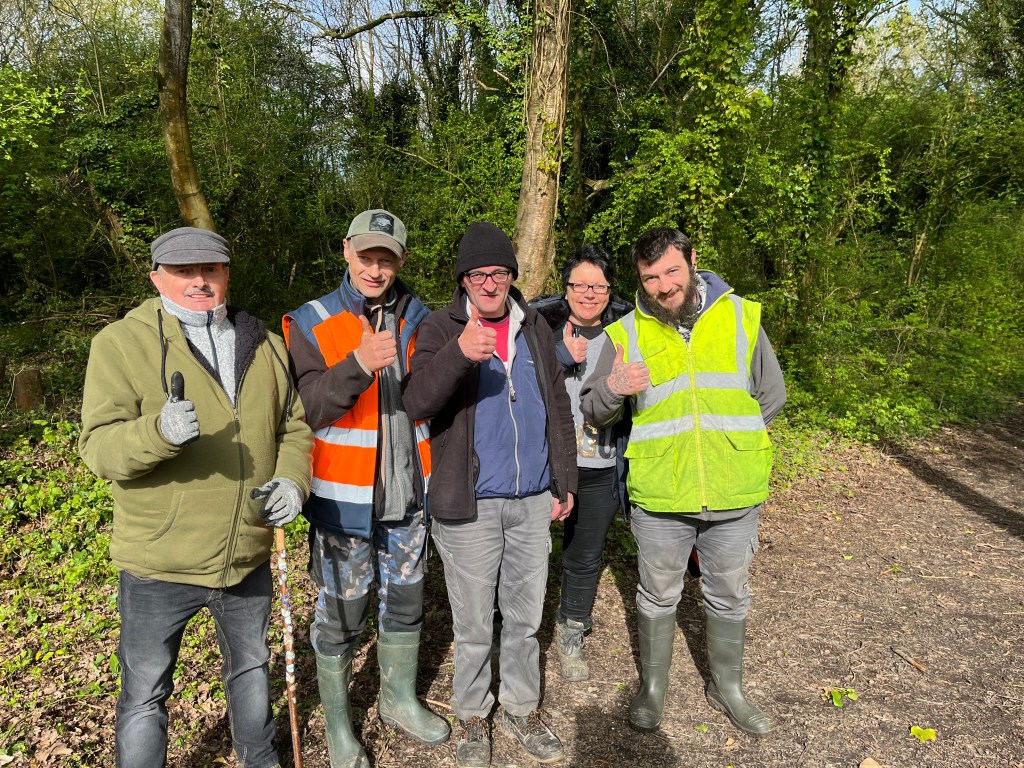
A little beyond Houchin, I noticed two men a distance on up the line. One had an orange hi-vis vest on. As I got nearer, we hailed each other heartily, and they asked who I was. This was very exciting, as it meant I got use all the pre-prepared pilgrim phrases I had prepared. Then some more people came over. From what I can gather they were volunteers who were maintaining the woodland, and some were learning how to chainsaw. I think the head chainsawerer (if that’s a word) had gone off for a part, so we were left to chat. It really does show how, even with the smallest amount of a language, how people can converse and get to know each other. I was able to describe the route of the Via Francigena, roughly how long it would take, and I even got to use my joke about not swimming the Channel. All in all an encounter that left me with a spring in my step. We parted with many “Bon marches” and more than an average helping of bonhomie.
The route now wound its way through countryside, before scaling the heights of the Parc d’Olhain. It was quite an effort to get up there in the rising heat of the day, but very much worth it at the top. This wooded park is chocked full of outdoor activities – cyclists and walkers were everywhere, there were rope courses, strange contraptions involving pulleys and trampolines on their side. Every three or four minutes small peloton of school children whizzed past on mountain bikes. Well, if I’m honest some whizzed, some wheezed past. The main activity centre seemed to have a Départmental gathering of firefighters going on. I passed two having a most conspiratorial conversation outside the reception. I wonder if one of the Pugh twins will ride the fire engine no more!
As I continued past a school party of 6 year olds eating packed lunches, I saw some paragliders waiting for a strong enough gust to get airborne. The “parapentiste” as I believe they like to be known in these parts finally hurtled off the edge of the hill after I had given up waiting to video him.
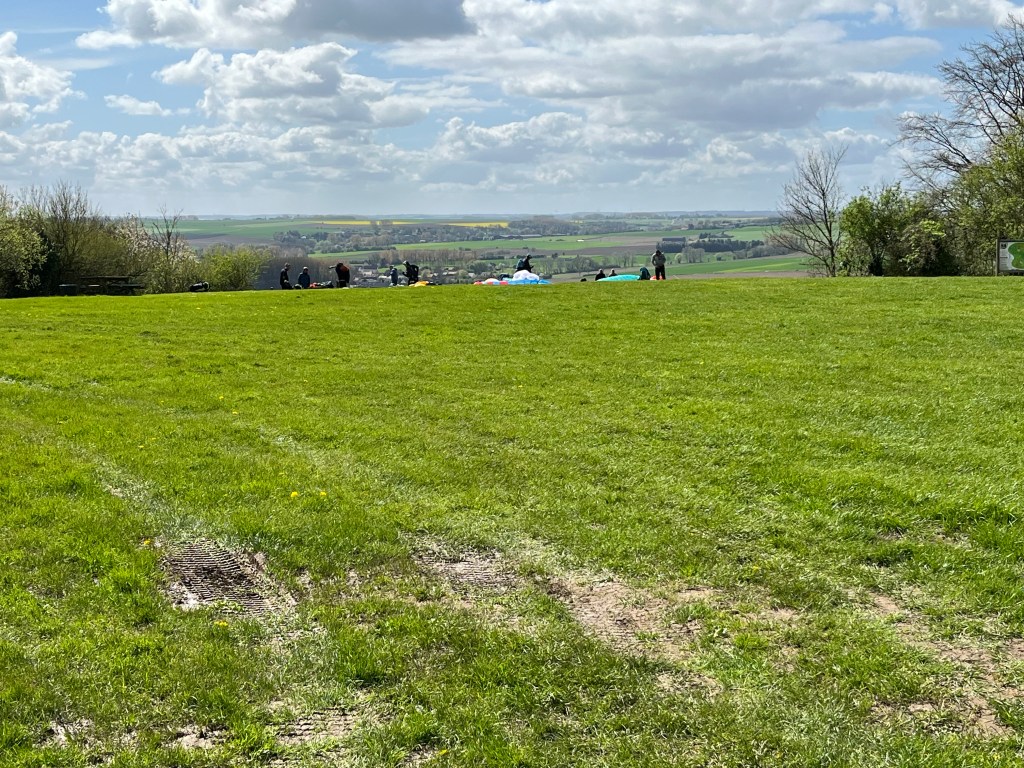
And so I made my own descent, not admittedly at quite the same velocity and spent much of the rest of the afternoon walking through quiet woodland and fields.
Finally as I neared my destination, I walked through a knot of villages. At Servins there was an tangible air of excitement: the circus was in town!

A show was in full swing. I could hear “oohs” and “ahs” from the Big Top. At one moment, a man dressed as a lion tamer came out of the side of the tent, bringing some equipment with him, before re-entering the fray. I strongly suspect there wasn’t an actual lion though: it was a small tent and it was a children’s performance. However there was a particularly fierce llama who stared at me as I walked past – maybe she was on next!
And so I made my final descent into Ablain St-Nazaire, my home for the night. This town marks the shift from mining district to First World War battlefield. As I type I can see the flashing light on top of the Basilica of the Notre-Dame de Lorette National Memorial. The resting place for over 40,000 French War Dead and behind the house here is the Sucrerie British War Cemetery. The town’s original church was destroyed by French shellfire after the place was captured by the Germans. Following the war, reparations were paid and a new church was built further to the west. The ruins of the old church serve as a memorial and a reminder of the cost of war, and the urgent need for peaceful cooperation between countries and peoples.

Tonight I am staying at the Chambre d’Hotes “coleurs et senteurs provençales” at the home of Sylviane Labenne. She wished me good fortune on the Via Francigena facebook group and I took her up on her offer of accommodation. I have had a most warm welcome and an excellent meal; both Sylviane and her husband have been most forebearing with my poor French.
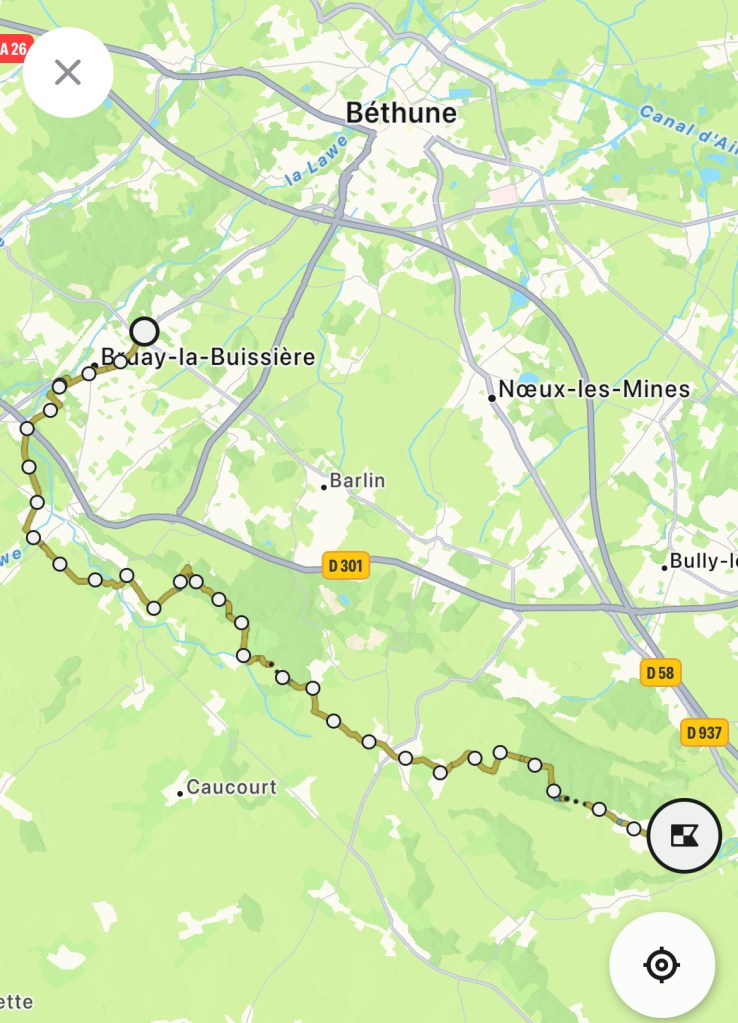
Tomorrow Arras and a rest day, but for those who like to see where I’ve been, here’s the map!


Leave a Reply